Nikola Tesla
Nikola Tesla was an inventor, engineer and electrical wizard. He invented, inspired or contributed to much of the electrical technology we take for granted, including remote control, fluorescent lighting, wireless transmission, X-rays and robotics.
He is probably best known for harnessing alternating current, forming the basis of our electrical systems today. Another invention that bears his name is the electrical transformer device known as the Tesla coil.
So who was this complex, enigmatic genius who achieved great fame and wealth during his lifetime, but died alone and poorly off?
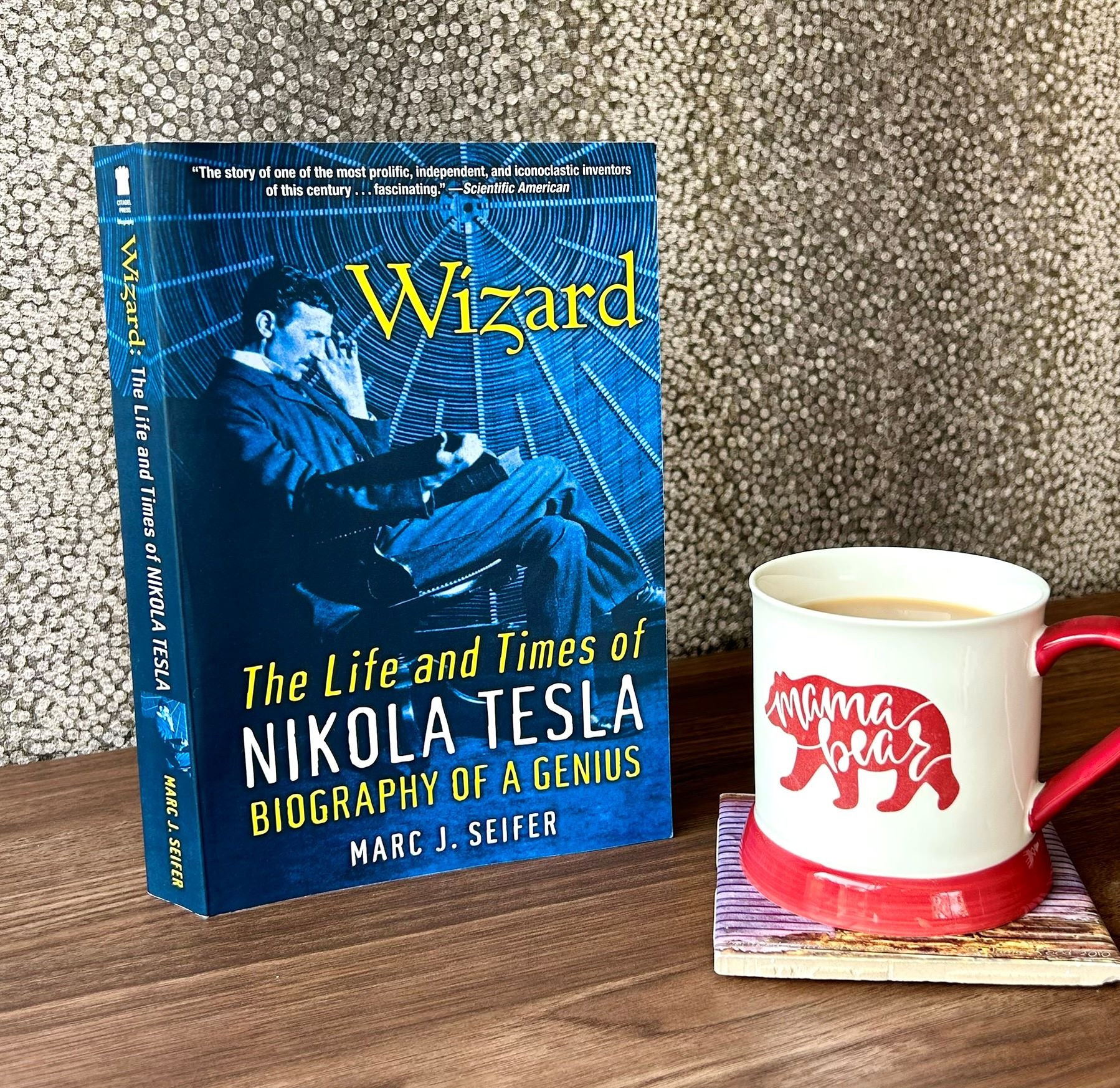
Wizard: The Life and Times of Nikola Tesla by Marc J. Seifer is a comprehensive account of the inventor's life, work, relationships and character.
Tesla was born in 1856 in Smiljan, Croatia to a Serbian family. Perhaps fittingly for someone whose name would become synonymous with electricity, he was born during a thunderstorm.
Tesla's father Milutin was an orthodox priest, a well-read man who also wrote editorials on social equality. Tesla's mother Djouka, who worked hard running the household and farm they lived on, was an inventor herself, coming up with ideas for kitchen tools and household appliances.
Tesla had an older brother, Dane - both were very gifted and had the ability of eidetic imagery. Tesla also had two older sisters, Angelina and Milka, and a younger sister, Marica.
It was an idyllic childhood, during which Tesla experimented with various inventions, inspired by his mother and older brother.
In 1863, the family were devastated when Dane died after being thrown from a horse. Following this tragedy, Tesla felt rejected by his parents and had nightmares of Dane's death.
The family moved to the town of Gospic after Milutin was given a new parish, but Tesla had trouble adjusting to this new life.
At school, Tesla fuelled his interest in electricity with further experiments. In 1870, at the age of fourteen, Tesla went to study in Karlovac.
After graduating, Tesla returned to Gospic, where there was a cholera epidemic. He caught it and was bedridden for nine months, nearly dying. On his sickbed, he persuaded his father to let him study engineering rather than entering the priesthood.
Tesla was due to serve three years in the army, but was told by his father to go and live in the hills to avoid the draft, which he did.
In 1875, Tesla attended the Polytechnic School in Graz, Austria. He worked hard and studied numerous courses, including languages. Other students became jealous of him, while his teachers became worried about his long hours of study.
Tesla then became bored and started gambling. He was unprepared for his exams and, despite his top grades in previous years, didn't graduate. He then disappeared.
His father eventually tracked him down and Tesla returned to Gospic. There he had a short-lived romance with a woman called Anna.
After his father's death, Tesla left to carry out his father's wish to continue his education. He enrolled in the Charles-Ferdinand branch of the University of Prague.
In 1881, Tesla moved to Budapest, where he found work at the Central Telegraph Office of the Hungarian government. When the new telephone exchange opened, Tesla found work there. He checked lines, repaired equipment and learned about the most modern inventions of the day, including the work of American inventor and businessman Thomas Edison.
Tesla spent his spare time working on harnessing AC (alternating current) without the aid of an intermediary device (the cumbersome commutator). This had become his obsession since the idea was dismissed by one of his tutors at Graz.
Inspiration came to him with the concept of a rotating magnetic field. (There is an explanation on how this works in the book, but I don't have a physics brain so I'm afraid I didn't understand it!) This discovery was the start - Tesla quickly invented motors using this concept.
Although others had similar ideas, it was Tesla who developed it further and made a practical invention that was revolutionary. Before his invention, electricity could be pumped only one mile to light homes. Afterwards, electrical power could be transmitted hundreds of miles and used to run appliances and machines.
"The day when we shall know exactly what electricity is, will chronicle an event probably greater, more important than any other..."
Nikola Tesla
In 1882, Tesla moved to Paris to work for the new Edison lighting company, Continental Edison. He was also looking for investors for his new motor.
Two years later, he moved to America to work at Edison's centre of operations in New York, where he got to know the man who would later become his rival. It all turned sour when Tesla thought he had been promised a lump sum for his work redesigning and improving equipment, and when he asked for it, Edison laughed and told him it had been a joke. Hurt by this, Tesla left the Edison company and set out on his own.
He set up the Tesla Electric Light and Manufacturing Company with two backers. But they weren't interested in Tesla's AC motor, and he was booted out of the company with only a meaningless stock certificate. Bankrupt, Tesla was forced to work as a ditchdigger.
He found more backers to form the Tesla Electric Company, and there followed intense activity with inventions and patents.
Tesla, now with a lab in New York, started to really make a name for himself, catching the attention of notable people, industry magazines and institutions.
Electricity was a lucrative business, with fierce competition amongst inventors and companies. The 'war of the currents' was under way - alternating current vs direct current. Edison favoured DC and considered AC to be dangerous. His rival, inventor and industrialist George Westinghouse was on the AC side. Westinghouse made a deal with Tesla, buying his patents to help further the AC systems he was already using. Tesla moved to Pittsburgh, where Westinghouse's plant was located, to help develop his motor.
Tesla returned to New York in 1889 to set up a new lab and work on new inventions and experiments, including wireless transmission, although he continued to help Westinghouse.
Tesla's fame grew, and he gave talks before members of the scientific community in America, London and Paris. His lectures were accompanied by dramatic practical demonstrations, with electricity going through his body, sparks coming out of him, and lights in his hands coming on. To those watching, he looked like an electric sorcerer.
Tesla went back to Gospic when he was notified his mother was dying. On his return to New York, he continued working on his advances in fluorescent lighting and wireless transmission of power.
Tesla became a US citizen in 1891. In 1893, he was one of many exhibitors at the Chicago World's Fair (Columbian Exposition).
Tesla, now a celebrity, moved in exalted circles. He became friends with influential editor Robert Johnson and his wife Katharine, and was also friendly with writer Mark Twain.
In 1895, Tesla's lab was destroyed by fire, which started in the floor below, possibly by a night watchman smoking. Although it was a terrible setback, Tesla nevertheless carried on.
Tesla would go on to set up a lab and experimental station in Colorado Springs, followed by the Wardenclyffe Tower project with the backing of financier JP Morgan - but when money ran out, the wireless telegraphy plant was abandoned.
In his later years, Tesla found himself in deeper financial straits. He had lived in hotels for much of his life, but amassed debts, moving from hotel to hotel without paying the bills.
He continued with revolutionary inventions, such as a helicopter airplane, ways of communicating with other planets, methods to provide free energy, and a death ray superweapon (which he thought would end all war). He also cared for and fed pigeons from his hotel room window and in the park. The Westinghouse company helped him out financially, giving him a pension to cover his living expenses.
In 1937, Tesla was run down by a taxicab. He suffered three cracked ribs and probably other injuries, but he refused to see a doctor.
In January 1943, Tesla died in his room at the Hotel New Yorker. He was eighty-six. His body was found by a maid the next day, and his cause of death was ruled to be coronary thrombosis.
After his death, US government agents impounded his papers to investigate any possible military dangers, but they were released. There are conspiracy theories over missing papers, however.
Nikola Tesla remains a fascinating figure, a man who was clearly ahead of his time. There is no doubt his ideas and work have made our lives so much easier. He was, as many have described him, the man who invented the twentieth century.
Comments